

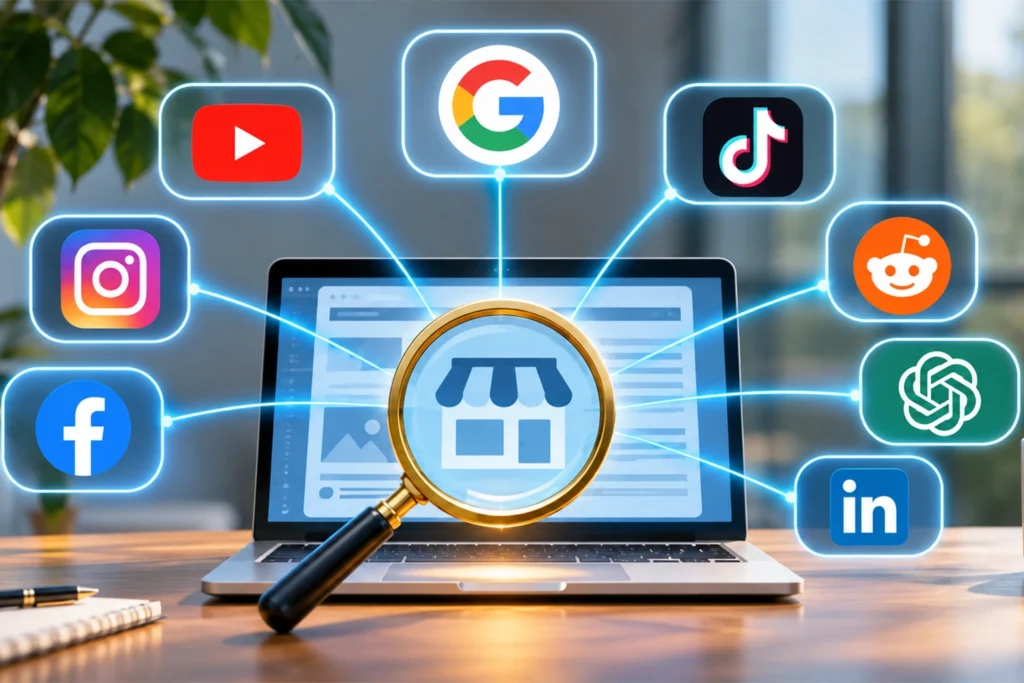
Seo is no longer just about ranking a website on google. Customers now search for businesses, products, services and recommendations across different online platforms. They use Youtube to watch tutorials, Facebook for reviews, tiktok to discover services, Reddit to read customer experiences, and Ai tools like ChatGPT to compare businesses and find answers.
This changes how businesses need to approach search engine optimization.
A company might have a well-optimized website and still miss potential customers because its brand is not visible where those customers are searching. Ranking on Google is still important, but it is no longer the only way people discover businesses.
This is where Search Everywhere Optimization comes in.
Search Everywhere Optimization goes beyond traditional SEO to optimise for the various platforms people use to look for information, to consider options and to make buying decisions. It encompasses social media platforms, video-sharing sites, online communities, local listings, marketplaces, and AI-powered search engines, among other factors.
The Business objective isn’t just to post more content or join each platform, it’s to produce quality content that supports each platform.The Business goal isn’t just more content or an account on each platform, it’s quality content that supports each platform. It is to ensure that all the correct information that they have about their brand is readily available wherever their target audience is likely to be.
It is especially crucial for service based companies, digital marketing firms, and companies heavily reliant on online inquiries for new customers.
What Is Search Everywhere Optimization?
Search Everywhere Optimization is a technique in digital marketing that does not only target the traditional search engines but also enhances the visibility of a particular brand in various search engines.
Traditional SEO primarily involves keyword research, content optimization, technical optimization, backlink building and user experience enhancement for boosting the ranking of a website.
These practices continue to be in force. But customers’ search habits have grown, though.
For instance, if someone is searching for a virtual assistant, they could start by searching Google for virtual assistant services. They may then head over to YouTube for some tips on outsourcing, open up LinkedIn to see what some of the company’s professionals said about it and read some posts on Reddit, or even run a chat with ChatGPT for some suggestions of virtual assistant service providers.
Each platform provides a different type of information. Whether you need help finding a website, a YouTube demonstration to get some ideas, a social media look at how brands interact, or you need some AI summary of the information or recommendations on potential service providers, Google is there.
SEO Everywhere understands these various discovery opportunities and designs a strategy to that effect.
The key here is that businesses are aware of where their customers are searching. Not all firms should focus on all platforms.
A local plumber, for instance, may be better served creating content on Google Business Profile, local search and social media, YouTube and customer reviews than dedicating a lot of time to those unrelated social media sites.
In this case, you might have to adopt a distinctive approach such as Google, LinkedIn, YouTube, and AI-powered search, which is available in a virtual associate agency.
The platforms might be different, but the goal is the same – keep the business findable, understandable and trusted.
Why Traditional SEO Is No Longer Enough
Traditional SEO is still a significant piece of online marketing activities. Businesses still require well optimized websites, content that is relevant, service pages that are helpful and technically accurate websites.
But simply relying on Google rankings comes with a set of limitations.
Purchase patterns are not consistent. Some people look for a service straight, others check out on videos, join forums, or utilize AI to whittle down choices.Some look for a service straight, others watch videos, join forums or utilize AI to limit down choices.
Imagine a business person in need of customer support and administrative services. The business owner will not need to rush off to an online virtual assistant agency, however; they can reach out to an AI assistant and ask something such as:
- What tasks can a virtual assistant handle?
- How much does it cost to hire a virtual assistant?
- Is outsourcing better than hiring an in-house employee?
- Which virtual assistant companies offer customer service support?
If a company has useful information on these subjects throughout their website as well as other trusted sites, they have more chances of being discovered.
However, if it’s relying on one keyword to be the sole foundation for its marketing campaign, then it is unlikely to be showing up for other keywords.
The other critical point is that SERPs are different. How people interact with traditional organic search results can be influenced by AI-generated answers, featured snippets, local, videos, and more search features.
Even if a site has a high ranking, less clicks will occur if users can obtain relevant information directly from a search result or AI-generated response.
This doesn’t imply traditional SEO methods can’t be of help either. It signifies that businesses should concentrate on brand visibility, qualified traffic, enquiries and conversions, rather than rankings.
Where People Search for Businesses Today
Search Everywhere Optimization does not mean focusing on Google, social media, and AI equally. Each platform has a different purpose, and customers use them differently.
Understanding these platforms helps businesses decide where to invest their time and marketing budget.
1. Google and Traditional Search Engines
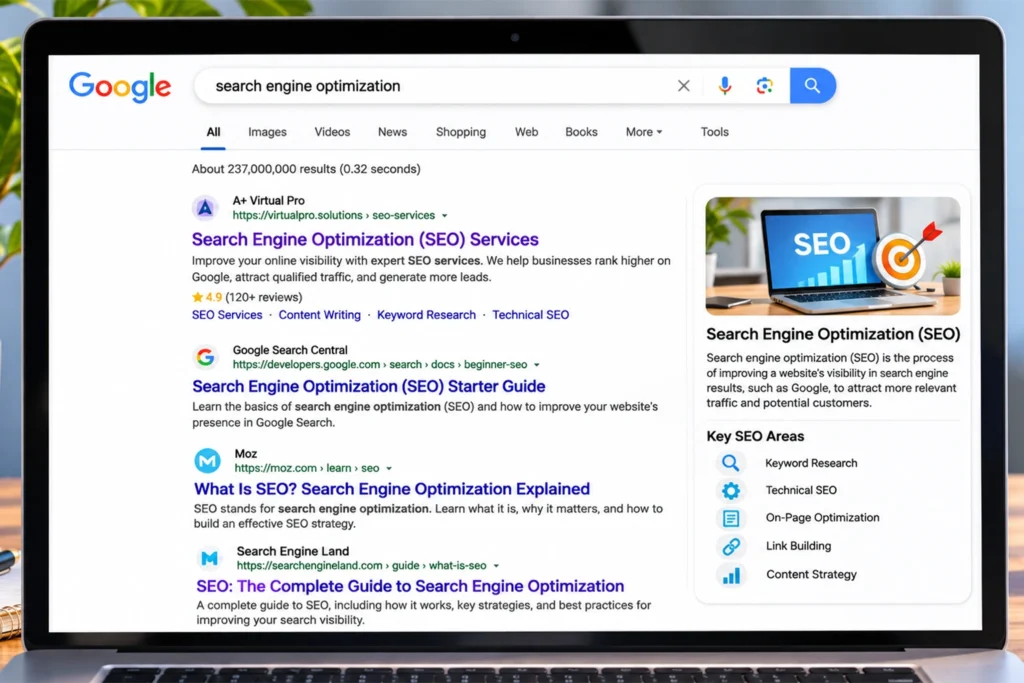
Google remains an important starting point for customers looking for products, services, and local businesses.
People search for specific services, compare providers, read articles, and check business locations. This makes traditional SEO essential.
Businesses should continue working on:
- Keyword research based on actual customer searches.
- Service pages that explain what the company offers.
- Helpful blog articles that answer common questions.
- Proper title tags, meta descriptions, and heading structures.
- Website speed, mobile usability, and technical SEO.
- Relevant backlinks and internal linking.
- Local SEO and Google Business Profile optimization.
For example, a company offering virtual assistant services should have dedicated pages explaining its services, including customer support, administrative assistance, bookkeeping, and digital marketing.
A general homepage may not provide enough information for someone searching for a specific service.
2. YouTube and Video Search
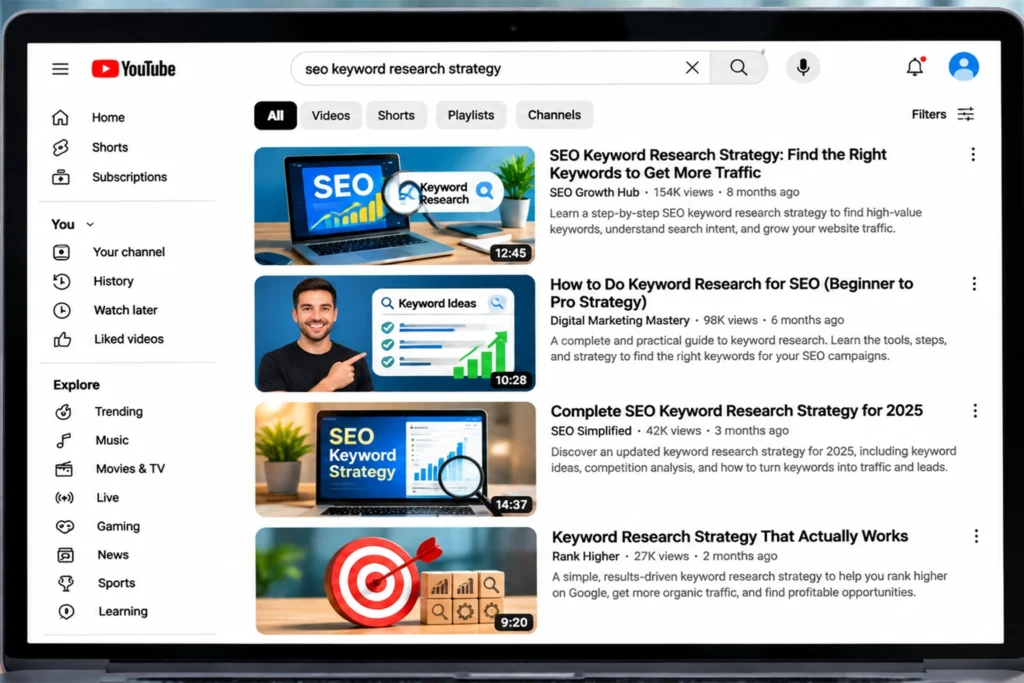
YouTube is more than a platform for entertainment. People use it to learn about services, understand complicated topics, compare products, and watch demonstrations.
For businesses, video content provides another opportunity to appear when customers search for relevant information.
A virtual assistant agency could publish videos explaining:
- What does a virtual assistant do?
- How can a virtual assistant help a small business?
- What tasks can businesses outsource?
- How does remote customer support work?
- What should business owners consider before hiring a virtual assistant?
Video optimization also requires its own approach. The video title should clearly describe the topic, the description should provide useful context, and the spoken content should address the question being searched.
Captions and transcripts can also make videos more accessible and provide additional text context.
Simply uploading a video does not guarantee visibility. The content needs to answer a real question and hold the viewer’s attention.
3. TikTok, Instagram, and Facebook Search
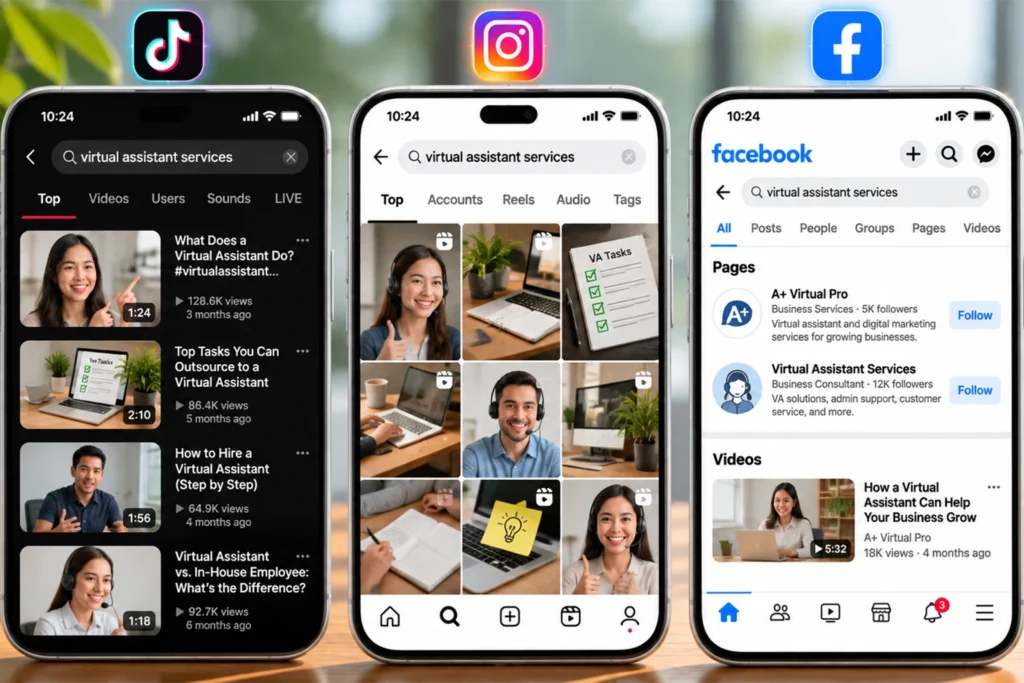
Social media platforms have become important discovery channels, especially for people looking for recommendations, demonstrations, business information, and customer experiences.
TikTok users may search for business advice, product recommendations, tutorials, and service explanations. Instagram users often discover brands through Reels, profiles, hashtags, and shared content.
Facebook also remains useful for local business discovery, community discussions, and recommendations.
Businesses can improve their social search visibility by:
- Using descriptive captions.
- Including relevant keywords in video titles and descriptions.
- Maintaining complete and accurate business profiles.
- Publishing useful educational content.
- Answering common questions through short videos.
- Encouraging genuine customer engagement.
- Keeping business details consistent across platforms.
For instance, a digital marketing agency could create a short video explaining three common SEO mistakes made by small businesses.
The video can attract people searching for SEO advice, while the agency’s profile gives interested viewers a way to learn about its services.
The content should be useful even when someone does not immediately become a customer.
4. Reddit and Online Communities
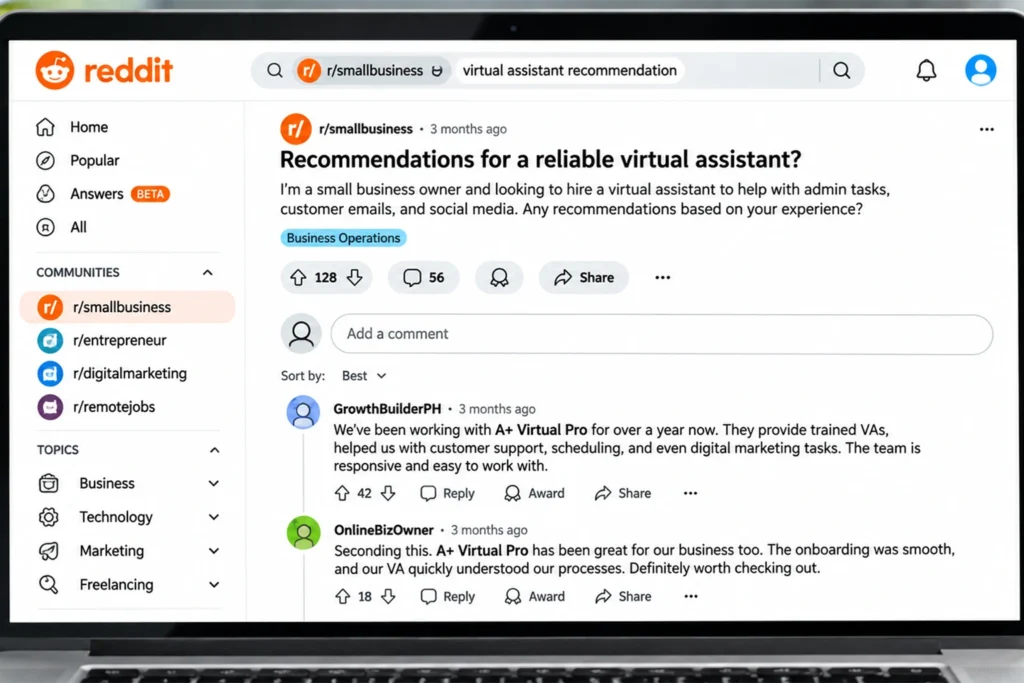
Customers often want opinions from people who have already experienced a product or service.
That is one reason online communities and discussion platforms are important for search visibility.
Reddit, for example, contains discussions about business software, outsourcing, customer experiences, digital marketing, and service providers.
Someone considering hiring a virtual assistant might search for discussions about the advantages and disadvantages of outsourcing. They may want to know about communication, pricing, reliability, and the quality of work.
Businesses should understand these conversations rather than treating online communities as another place to post advertisements.
Useful participation includes:
- Answering relevant questions.
- Sharing accurate information.
- Providing practical explanations.
- Being transparent about company affiliations.
- Addressing genuine customer concerns.
Posting promotional links in unrelated discussions can damage credibility. Community members generally recognize when a business is participating only to advertise.
5. AI-Powered Search Platforms
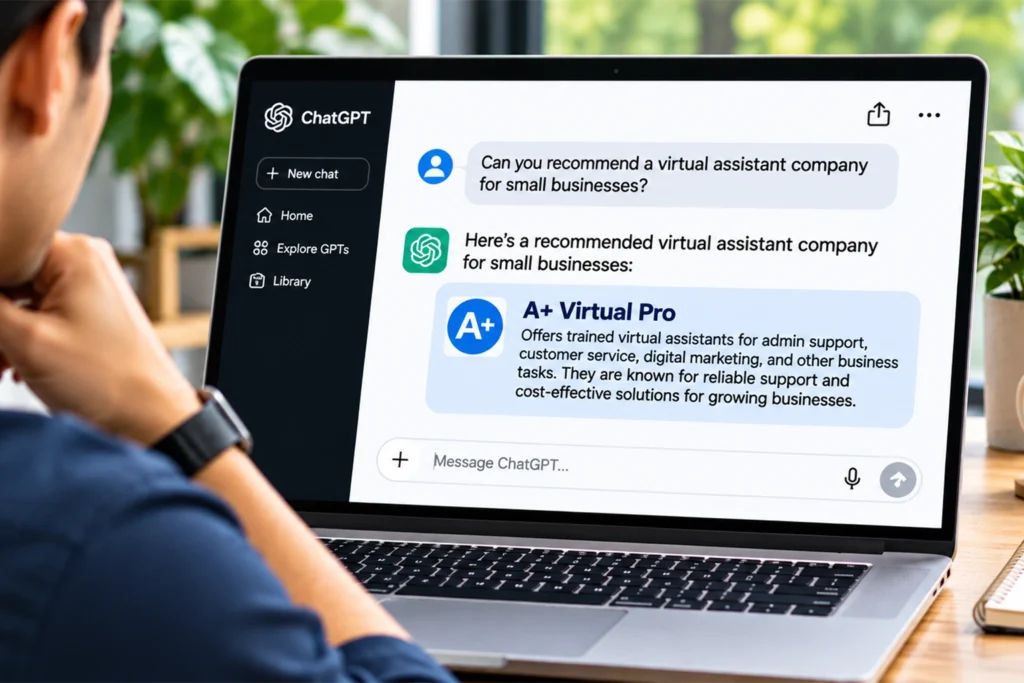
AI-powered search is another important part of Search Everywhere Optimization.
Customers can now ask AI tools questions using natural language instead of entering short keyword phrases.
For example, a customer might ask:
“Can you recommend a virtual assistant company that provides administrative support and customer service for small businesses?”
An AI system may generate an answer using information available from websites and other sources. Depending on the platform and query, it may mention businesses, summarize services, or provide links to supporting pages.
This creates a new visibility opportunity.
Businesses should make sure their online information is accurate, detailed, and easy to understand.
Important steps include:
- Clearly explaining services and specializations.
- Publishing useful articles that answer customer questions.
- Maintaining consistent company information.
- Providing real examples of experience and expertise.
- Keeping outdated information updated.
- Making important website content accessible to search crawlers.
- Building a trustworthy online presence.
AI visibility is not guaranteed by adding certain keywords or using a specific content format. Different systems may select different sources depending on the question and available information.
How to Build a Search Everywhere Optimization Strategy
Businesses do not need to change their entire marketing operation overnight. A better approach is to start with the existing SEO foundation and gradually expand into other relevant platforms.
Here are practical steps to follow.
Step 1: Understand Where Your Customers Search
Before creating content, identify how your target audience looks for information.
A business selling professional services may attract customers through Google, LinkedIn, YouTube, and AI tools.
An online store may need to prioritize Google Shopping, Amazon, Pinterest, and product-focused social content.
Look at your existing website analytics, search queries, customer inquiries, social media engagement, and referral sources.
Ask existing customers how they discovered your business. Their answers can help identify channels that deserve more attention.
The objective is to understand customer behavior before investing in new platforms.
Step 2: Build a Strong Website and SEO Foundation
Your website should remain the main source of accurate information about your company.
Make sure important pages explain:
- What your business does.
- Which services you provide.
- Who your services are intended for.
- What problems you help solve.
- How customers can contact you.
- What makes your company qualified to provide the service.
For A+ Virtual Pro, this means creating clear service information about virtual assistants, digital marketing, customer service, administrative support, and other available solutions.
Each service should have enough detail to help potential customers understand what they are paying for.
Avoid relying on vague statements such as “We help businesses grow.” Explain how the service works and what tasks are included.
Step 3: Create Content Around Customer Questions
Keyword research should go beyond identifying popular search terms.
Businesses need to understand the questions customers ask before making a decision.
For example, someone interested in outsourcing might search for:
- What is a virtual assistant?
- What tasks can a virtual assistant handle?
- How much does a virtual assistant cost?
- How do I hire a remote assistant?
- What is the difference between a virtual assistant and an employee?
These questions can become blog articles, service-page sections, videos, social media posts, and FAQs.
One well-researched article can also support several related content formats.
However, each version should be adapted to its platform. A detailed blog article should not simply be copied word for word into a short TikTok video.
Step 4: Optimize Content for Each Platform
Different platforms have different content requirements.
A blog article needs useful headings, clear explanations, relevant keywords, and internal links. A YouTube video needs a descriptive title and engaging presentation. A social media post needs to communicate its message quickly.
AI search requires clear and accurate information that can be understood in context.
The main facts should remain consistent across platforms, but the presentation should match how people use each channel.
This is where content planning becomes important. Businesses should maintain a schedule that identifies the topic, target audience, platform, format, and purpose of every piece of content.
Step 5: Build Brand Authority and Trust
Visibility is not enough if customers cannot verify whether a business is reliable.
People want to know whether a company has the experience, knowledge, and resources to provide the service they need.
Businesses can strengthen credibility by publishing:
- Detailed service descriptions.
- Case studies based on real client work.
- Genuine customer testimonials.
- Educational articles written or reviewed by knowledgeable professionals.
- Author information and relevant qualifications.
- Accurate contact and company information.
- Examples that explain how services are delivered.
For example, A+ Virtual Pro can use its existing content about AI in digital marketing to explain how AI-assisted research, task management, and content development support its services.
That kind of information is more useful than publishing general statements about being an innovative agency.
Step 6: Track Results Across Different Platforms
Traditional SEO reporting often focuses on rankings, impressions, clicks, backlinks, and organic traffic.
These metrics remain useful, but a broader strategy needs additional measurements.
Businesses should also monitor:
- Referral traffic from social platforms.
- Video views and audience retention.
- Social profile visits and engagement.
- Branded search growth.
- Leads generated from different channels.
- Customer inquiries and completed conversions.
- Brand mentions and citations in AI-generated answers, where measurable.
Not every platform provides the same reporting data. Some AI visibility measurements also rely on repeated query testing and may vary between users, locations, and sessions.
For that reason, businesses should avoid treating one AI response as proof of consistent visibility.
The goal is to understand which channels contribute to awareness, inquiries, and actual business results.
Common Search Everywhere Optimization Mistakes Businesses Should Avoid
Expanding SEO across multiple platforms creates opportunities, but it can also lead to wasted time and marketing resources when the strategy is not properly planned.
Here are some mistakes businesses should watch out for.
1. Trying to Be Active on Every Platform
Having a presence on every social media platform does not automatically improve search visibility.
A business might create accounts on TikTok, Instagram, Pinterest, LinkedIn, YouTube, and Reddit but struggle to maintain useful content on any of them.
Instead, prioritize platforms where potential customers are already searching.
Start with two or three relevant channels, measure the results, and expand when resources allow.
2. Publishing the Same Content Everywhere
Reusing content is not necessarily a problem. The mistake is publishing identical material without considering the platform.
A detailed blog article may work well on a website, but it might be too long for a short-form video.
A LinkedIn post may need a professional explanation, while a TikTok video may need a quick demonstration.
Repurposing content should involve adapting its format, structure, and presentation.
3. Depending Too Much on AI-Generated Content
AI tools can help with keyword research, content planning, topic clustering, and drafting. However, publishing large amounts of AI-generated content without human review can create problems.
Articles may contain repeated explanations, inaccurate statements, generic advice, or information that does not reflect the company’s actual services.
Businesses should review every piece of content for accuracy, usefulness, originality, and relevance.
A+ Virtual Pro’s approach to AI-assisted marketing emphasizes combining automation and AI capabilities with human creativity, judgment, and expertise. That distinction matters when producing content intended to build customer trust.
4. Ignoring Customer Reviews and Brand Reputation
Search visibility is only one part of the customer decision-making process.
A business may appear in search results, but potential customers can still choose a competitor if they find better reviews, clearer service information, or stronger evidence of experience.
Businesses should monitor customer feedback, respond professionally, correct inaccurate information, and encourage genuine reviews from customers.
Do not purchase fake reviews or create misleading testimonials. These practices can damage credibility and violate platform policies.
5. Focusing Only on Rankings
Ranking first for a keyword does not automatically mean a business is generating qualified leads.
A company might receive thousands of website visits but very few inquiries because the content attracts the wrong audience or fails to explain its services.
Track what happens after someone discovers the brand.
Do visitors explore service pages? Do they contact the company? Are they qualified leads? Do they become customers?
These questions provide a more useful picture of SEO performance than rankings alone.
What Happens If Businesses Ignore Search Everywhere Optimization?
Companies may be losing out on the other channels where people are searching for them.
Don’t despair, though: This won’t result in the immediate demise of every business from Google’s ranking or search lists. The danger will be that the competition will be seen closer to the market where you’re trying to go.
There are a number of implications that can be drawn.
Less brand visibility: People who use social media, online communities and AI search tools could potentially see competitors rather than the brand.
Relying on a single traffic source – If your website gets a lot of its visitors from a single search engine, shifting its algorithms or user experience can affect your site.
Customer queries that are not answered: Other businesses may be able to help answer customer questions, but they give their information out in an easier way on other platforms.
Sparse brand information: If a company has not valuable information available other than on its own website, it might have less opportunities to showcase its knowledge and credibility.
Failure to quantify the customer journey: When just one channel is the priority in marketing campaigns, other platforms can be forgotten which could be impacting customer decisions.
These issues don’t just occur out of the blue, and being in all places is no solution. It is not the number of channels but the consistency and usefulness of presence in the channels that impact and reach the target audience.
When Should Businesses Start Using Search Everywhere Optimization?
Businesses should start expanding their SEO strategy when they recognize that their customers are discovering and evaluating services through more than one platform.
It is especially relevant for:
- Small businesses: Companies that want to reach customers beyond traditional organic search.
- Service-based businesses: Companies that depend on customer inquiries, recommendations, and local discovery.
- Digital marketing agencies: Agencies that need to demonstrate expertise across search engines, social platforms, and AI tools.
- E-commerce businesses: Online stores that depend on product discovery through search engines, marketplaces, and social media.
- Professional service providers: Businesses that need to establish credibility before customers schedule consultations or request quotes.
It is also worth reviewing an existing SEO strategy when website traffic is stable but qualified leads are declining, competitors are becoming more visible on other platforms, or customers increasingly mention discovering services through AI recommendations and social media.
The earlier a business understands these changes, the easier it is to develop a practical content strategy without having to rebuild everything at once.
How A+ Virtual Pro Can Help Businesses Adapt to Search Everywhere Optimization
In the world of search everywhere optimization, it is not enough to just publish blog articles and publish tweets on social media. Its process includes research, creation of content, platform management, optimization and monitoring of their performance.
There also needs to be an individual who is able to run those activities in a consistent way for businesses.
Here is where A+ Virtual Pro can assist businesses with its virtual assistant and Digital marketing services.
In addition there are support services that businesses can use, such as:
SEO research and content planning: Identification of relevant keywords, research of customer’s questions, preparation of content topics and the creation of content that meets the specific searcher’s purpose.
Content Writing and Optimization: Developing blog posts, service pages, website description, and other articles that generate helpful content and enhance their organic reach.
Social media management: Content creation for social platforms, setting up social media calendars and general social media branding.
Digital marketing support: Assisting in coordination, review of marketing activity and organizing activities on various digital platforms.
AI marketing: Leveraging AI technologies to aid in research, content creation, and marketing processes alongside human review and oversight.
The important thing is to have a clear process. However, businesses should be aware of the platforms they are targeting, what type of content required, and who will be responsible for creating it, along with how they will be knowing it has succeeded.
With virtual assistance and digital marketing support, A+ Virtual Pro can assist companies to manage these activities without having to do all of the marketing activities themselves.
SEO Needs to Go Beyond Google
SEO is evolving as people’s methods for finding information and businesses have evolved.
Even though customers are still searching on Google, they are also searching on platforms such as YouTube, TikTok, Reddit, LinkedIn, AI-powered tools and online marketplaces. There are unique ways of finding information, comparing options and assessing business on each platform.
To counter this shift, SEO approaches have been broadened to include Search Everywhere Optimization.
This doesn’t mean, however, that businesses have to have content published everywhere. The key to a successful strategy is to understand customer behavior, then identify the right marketing platforms, establish valuable information, and keep your brand information up-to-date.
The main premise continues to be traditional SEO. Keyword research, technical optimization, quality content, backlinks, and a good website experience are still important. The way businesses are sharing information and tracking their visibility has changed.
Once companies realize that SEO isn’t just about rank on web pages, they then need to fully grasp the necessary steps to become more competitive. Consider where customers look for information, what they want to know and if your business offers it.
The goal is straightforward: put your business in front of your potential customers where they look for answers and make them believe it.